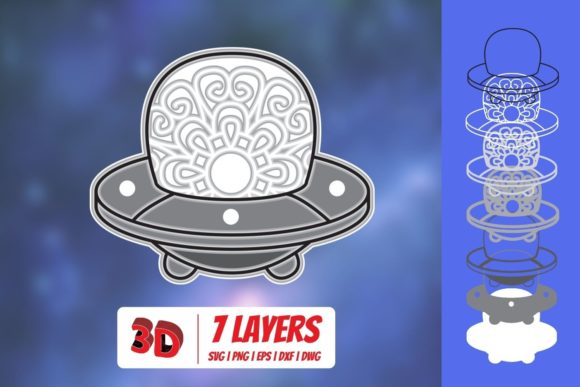
3D Flying Saucer SVG
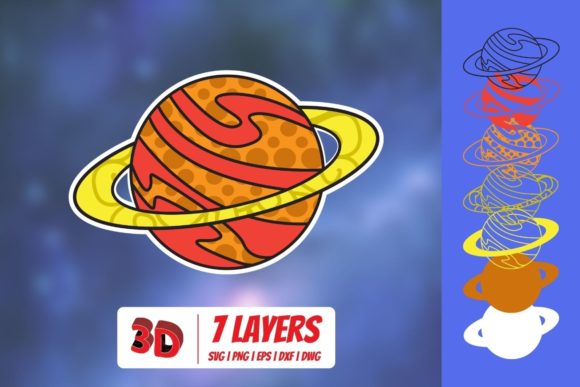
The concept of a flying saucer often conjures images of retro sci-fi posters or childhood toys, but in the digital crafting and design world, it represents a versatile vector asset that bridges creativity with technical precision. The 3D Flying Saucer SVG is not merely a flat image; it is a layered digital file designed to create depth, shadow, and dimension when cut or printed. This specific download package includes multiple formats—SVG, DXF, PNG, and EPS—packaged in a zipped folder to ensure compatibility across a wide range of software and hardware ecosystems.
For many users, the appeal lies in the "3D" aspect. Unlike a standard two-dimensional silhouette, this design utilizes overlapping paths and strategic layering to mimic a three-dimensional object. Whether you are creating a wall decal, a custom t-shirt graphic, a classroom poster, or a commercial product, understanding how these files function is crucial for achieving a professional result. The inclusion of various file types means that regardless of your skill level or the software you prefer, there is a pathway to using this asset effectively.
Understanding the File Formats and Software Compatibility
The strength of this digital asset lies in its multi-format approach. Each format serves a distinct purpose, catering to different workflows and user needs. Understanding which file to use can save time and prevent frustration during the design process.
- SVG (Scalable Vector Graphics): This is the primary format for modern cutting machines. The 3D Flying Saucer SVG is fully compatible with Cricut Design Space, Silhouette Designer Edition, Make the Cut (MTC), Sure Cuts A Lot (SCAL), and Brother ScanNCut’s Canvas software. Because it is a vector file, it can be resized infinitely without losing quality, making it ideal for projects ranging from small stickers to large wall decals.
- DXF (Drawing Exchange Format): This legacy format is essential for users who do not have access to premium software suites. It works seamlessly with Silhouette Basic Edition and other entry-level cutting machine software. If you are just starting out or need a lightweight file that requires minimal processing power, the DXF version ensures you are not locked out of the project due to software limitations.
- EPS (Encapsulated PostScript): For professional graphic designers, the EPS file is the gold standard. It is compatible with industry-leading tools like CorelDRAW, Inkscape, and Adobe Illustrator. This format allows for advanced editing, color separation, and integration into larger print layouts. Professionals often prefer this format because it maintains precise bezier curves and node data, allowing for fine-tuned adjustments before sending the file to a plotter or printer.
- PNG (Portable Network Graphics): Included in the zip folder is a high-resolution PNG file with a transparent background at 300 DPI. While this is a raster image and cannot be cut by a machine, it is perfect for digital printing, social media graphics, web banners, or as a reference image while working in vector software. Its transparency makes it easy to overlay on any background without unwanted white boxes.
Why Different Audiences Care About 3D Effects
The "3D" designation in the 3D Flying Saucer SVG is not just a marketing term; it dictates how the final physical product looks. For beginners, this feature simplifies the creation of complex-looking designs. Instead of manually calculating shadows and offsets, the layers are pre-configured. However, for experienced creators, the value lies in customization. They might adjust the offset distances between layers to change the depth effect, or swap colors to match a specific brand palette or seasonal theme.
Entrepreneurs and small business owners see this asset as a way to increase perceived value. A simple flat sticker is common, but a layered, dimensional sticker stands out on shelves and in online marketplaces. The ability to produce a high-quality, multi-layered product quickly can be a competitive advantage. Similarly, educators may find the 3D aspect engaging for students learning about space, geometry, or engineering. Creating a physical model from a digital file helps bridge the gap between abstract concepts and tangible reality.
Practical Applications Across Skill Levels
How you use the 3D Flying Saucer SVG depends largely on your goals and technical comfort zone. Here is how different groups might approach this asset:
Beginners and Hobbyists
If you are new to crafting, start with the SVG file and Cricut Design Space or Silhouette Maker. These platforms offer intuitive interfaces where you can import the file, separate the layers, and assign different colors to each layer. The 3D effect is achieved by cutting each layer separately and then adhering them together. This teaches fundamental skills in layer management and material selection without requiring advanced design knowledge. You might use this to create a fun room decoration or a personalized gift for a friend interested in astronomy.
Professional Designers and Marketers
For those using Adobe Illustrator or CorelDRAW via the EPS file, the focus shifts to precision and scalability. A marketer might use the 3D Flying Saucer SVG to create eye-catching social media assets or email newsletter headers. The vector nature ensures crisp edges on any screen size. A designer could also deconstruct the layers to create a custom logo or icon set, extracting the saucer shape as a base element for broader branding work. The flexibility of the EPS format allows for seamless integration into existing design systems.
Educators and Content Creators
An educator teaching physics or space science could use the PNG file to create clear, high-contrast diagrams for presentations or handouts. Alternatively, they might guide students through the process of importing the DXF or SVG file into a cutting machine, turning a lesson on aerospace history into a hands-on STEM activity. Bloggers and publishers can use the PNG for featured images, ensuring their articles have a visually appealing thumbnail that draws clicks without compromising load times.
Evaluating Quality and Long-Term Usefulness
When selecting a digital asset, reliability and quality are paramount. The 3D Flying Saucer SVG offers long-term usefulness because vectors do not degrade over time. Unlike a JPEG or PNG, which can become pixelated if enlarged, an SVG remains sharp at any scale. This makes it a sustainable investment for your digital library. Furthermore, the inclusion of multiple formats future-proofs your workflow. As your software evolves or as you switch between personal and professional tools, having both SVG and EPS versions ensures you are never left without a usable file.
Creativity is another key factor. The 3D effect invites experimentation. You might try using metallic vinyl for the outer ring and matte vinyl for the inner details to enhance the visual contrast. Or, you could use translucent materials to simulate the glow of lightsabers or engine exhausts. The possibilities are limited only by your imagination and the materials you choose to work with.
Identifying Your Fit
Does the 3D Flying Saucer SVG match your needs? If you are looking for a quick, high-impact graphic for a one-off project, the PNG provides immediate ease of use. If you plan to sell physical products, the SVG and DXF files provide the necessary precision for cutting machines. If you are building a comprehensive design portfolio or integrating the graphic into complex illustrations, the EPS file offers the control professionals require.
Ultimately, the value of this asset is defined by how well it integrates into your existing workflow. By providing a comprehensive package that supports everything from basic cutting to advanced vector editing, the 3D Flying Saucer SVG caters to a broad spectrum of creative intentions. Whether you are a seasoned pro refining a client project or a beginner exploring the joys of digital crafting, this multi-format resource offers the flexibility and quality needed to bring your vision to life.